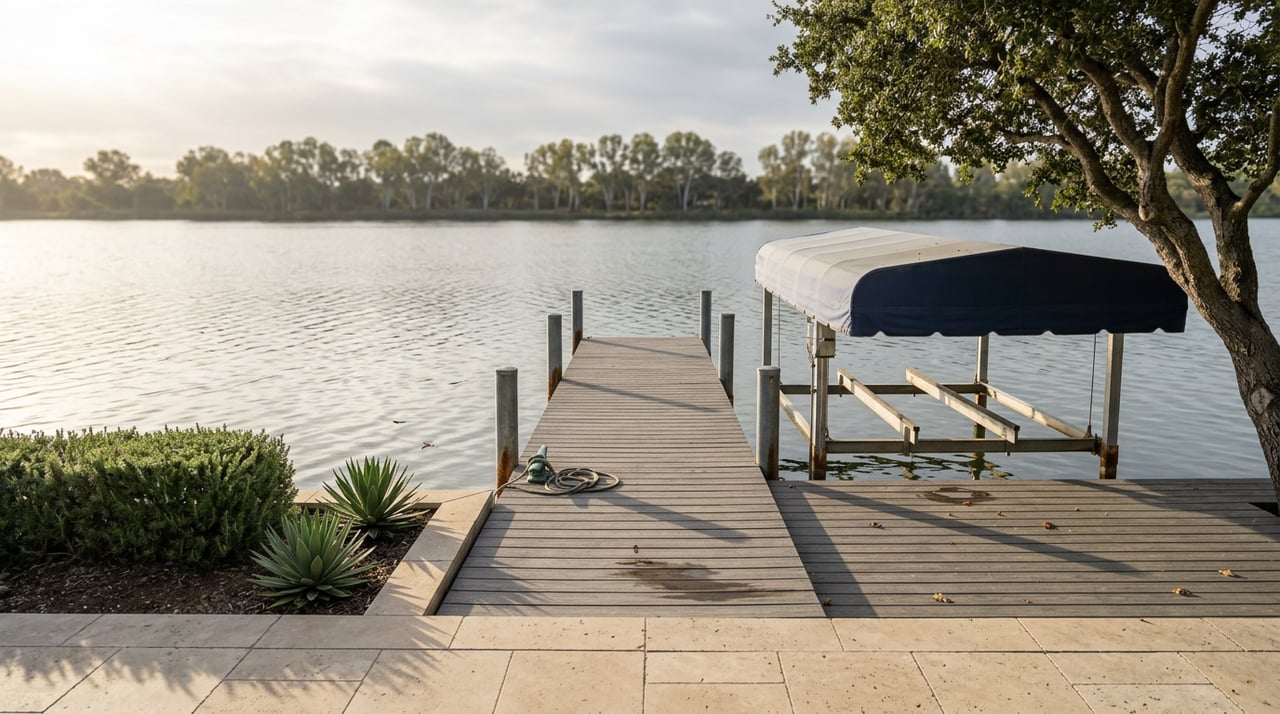
A Canyon Lake seller with a dock out back tends to worry about the wrong thing first. They picture a buyer's financing falling through, or an inspector finding something in the crawl space. What actually slows these closings down almost never touches the house. It starts the moment escrow opens, and it starts whether the seller is ready or not.
Here is the mechanism most sellers do not know exists until they are living inside it. The Canyon Lake Property Owners Association runs a Planning and Compliance inspection automatically at the opening of every escrow. Nobody requests it. It is not optional, and it is not tied to whether the home has ever had a complaint filed against it. The inspection exists to flag anything on the property that was never permitted or never brought back into compliance, and if the prior owner has not resolved those items by the time escrow closes, the new owner inherits them. Not as a disclosure item to note and move past. As a standing violation with the seller's name no longer on the account.
For a house with a dock, that inspection has more to look at than most. Shoreline improvements in Canyon Lake are governed separately from the rest of the CC&Rs, and the paperwork trail for a compliant dock runs through the Architectural Control Committee and, in many cases, a recorded Shoreline License Agreement executed by the owner, the POA, and the Elsinore Valley Municipal Water District, which actually owns the lakebed and leases recreational rights to the association. If that agreement was never recorded, or the ACC approval for a rebuild or repair was never filed, the Planning and Compliance letter that lands mid-escrow is the first time anyone finds out.
The clock nobody controls but the seller
The part that catches people off guard is not that violations get flagged. It is when.
By the time that letter arrives, the buyer's lender is usually already counting days toward a closing date. An unresolved dock issue at that point is not a two-day fix. It can mean pulling old permit records that were never filed, hiring a surveyor to confirm the structure sits within the surveyed contour lines the ACC uses to judge placement, or in the worst case, submitting a new improvement application and waiting through the committee's review cycle. None of that happens on the lender's schedule. It happens on the POA's.
The fix is almost embarrassingly simple, and it is exactly the kind of prep work a seller should be doing before a home ever goes on the market rather than after an offer is accepted. Before listing, pull the Planning and Compliance file on the property. Ask whether the dock has a recorded Shoreline License Agreement on file, and if it does not, decide now whether to record one rather than let a buyer's lender discover the gap. Gather any ACC approval letters for past dock work, additions, or pool installations. If a bond was posted for a prior improvement, get written confirmation from the POA that it was released. All of this is available to a property owner well before an escrow date exists to pressure the timeline.
Why the demand letter waits on you, not the buyer
There is a second piece of friction that is less about the dock and more about how the association is structured, and it reveals something worth sitting with. CLPOA will not process a demand letter, the document that tells escrow exactly what is owed on the account before it can close, until it receives written authorization from the seller. Not the buyer's agent. Not the escrow officer. The seller.
This is a small rule with an odd effect. The person with the least reason to move quickly, a seller who is usually mid-move and juggling ten other things, holds the one signature that starts a ten-day clock for the association to turn around a complete demand request. Buyers and their lenders cannot speed this up by pushing harder. They can only wait on an authorization that sits in the seller's inbox.
Sellers who know this ahead of time can neutralize it entirely by signing the authorization and ordering the resale package through HomeWiseDocs, the platform CLPOA uses for escrow documents, as soon as they decide to list rather than as soon as they accept an offer. That single step removes the one delay in the entire process that has nothing to do with the house, the buyer, or the market, and everything to do with a signature that was sitting unsigned.
What the dock itself is going to cost someone
The financial side of a Canyon Lake dock is not one number, it is several, and a seller who cannot answer these questions accurately in the listing conversation is going to answer them awkwardly during negotiation instead.
In the association's most recently published annual budget, covering the fiscal year that closed at the end of April 2026, CLPOA's regular assessment ran $4,200 per lot, payable in full or in monthly installments. That figure resets each May, so a seller should confirm the current number with Member Services rather than quote last year's budget to a buyer. The same budget cycle put annual moorage at roughly $1,752 for a slip with electric service and about $1,644 without it, and listed a $265 filing fee, a $1,155 dock bond, and a separate $1,155 removal bond for adding, replacing, or removing a dock, on top of any survey or engineering costs the ACC requires for placement. Treat all of those as last year's benchmarks, not this year's invoice, and verify the live numbers before writing them into a listing or a net sheet.
None of that is disclosed automatically to a buyer browsing photos of a private dock and a covered boat slip. It becomes real the moment their agent asks whether the slip transfers with the sale, whether it is shared among multiple owners on the same dock, and whether there is a waitlist involved if it does not. CLPOA controls slip assignment and waitlists at community facilities directly, which means a seller who assumes the dock simply comes with the house may be wrong, and a buyer who assumes the same may be planning a summer around a slip that was never guaranteed to convey.
The version of due diligence that actually protects a seller
Every one of these friction points shares the same fix. Resolve it before the home is listed, not after an offer arrives.
That means, in practice: request the Planning and Compliance file on the property and clear anything outstanding. Confirm the Shoreline License Agreement is recorded, not just remembered. Pull ACC approval letters for any dock, pool, or major exterior work done during ownership, and confirm any bonds tied to that work were released. Sign the seller authorization for the demand request early rather than waiting for escrow to ask for it. Know exactly what the slip situation is, whether it transfers, whether it is shared, and what the current moorage rate actually costs, before a buyer's agent asks.
A seller who walks into a listing appointment with those answers already in hand is not doing anything glamorous. They are simply removing every piece of friction that has nothing to do with their home's condition or their asking price, and everything to do with a set of documents that were always theirs to gather.
A few questions that come up almost every time
Does the boat come with the house? Not automatically, and not by assumption. The boat and the slip are two separate things, and only the slip, if it transfers at all, is tied to the property. Confirm both in writing before listing.
Do I need a current safety certificate to sell? The POA requires a Safety Certificate at registration and renewal every two years or upon change of ownership, so a buyer inheriting a boat as part of the sale will need one regardless of when the seller's was last issued.
What if I never recorded a Shoreline License Agreement and my dock has been there for years? Longevity is not the same as compliance. If the agreement was never recorded, that gap is exactly what the Planning and Compliance inspection at escrow opening is designed to catch, so it is worth resolving before listing rather than during a buyer's contingency period.
Selling a waterfront home in Canyon Lake is not harder because of the market. It is harder because the paperwork has its own timeline, and that timeline only moves at the pace a seller sets. Handled early, none of it slows a closing down. Handled late, all of it can.
If you are weighing a listing on the water in Canyon Lake and want a clear read on what your dock, your slip, and your compliance file actually look like before you go to market, The Hertz Group can walk through it with you. Start with a free home valuation or reach out through our sellers page to talk through your specific dock and paperwork situation before you list.