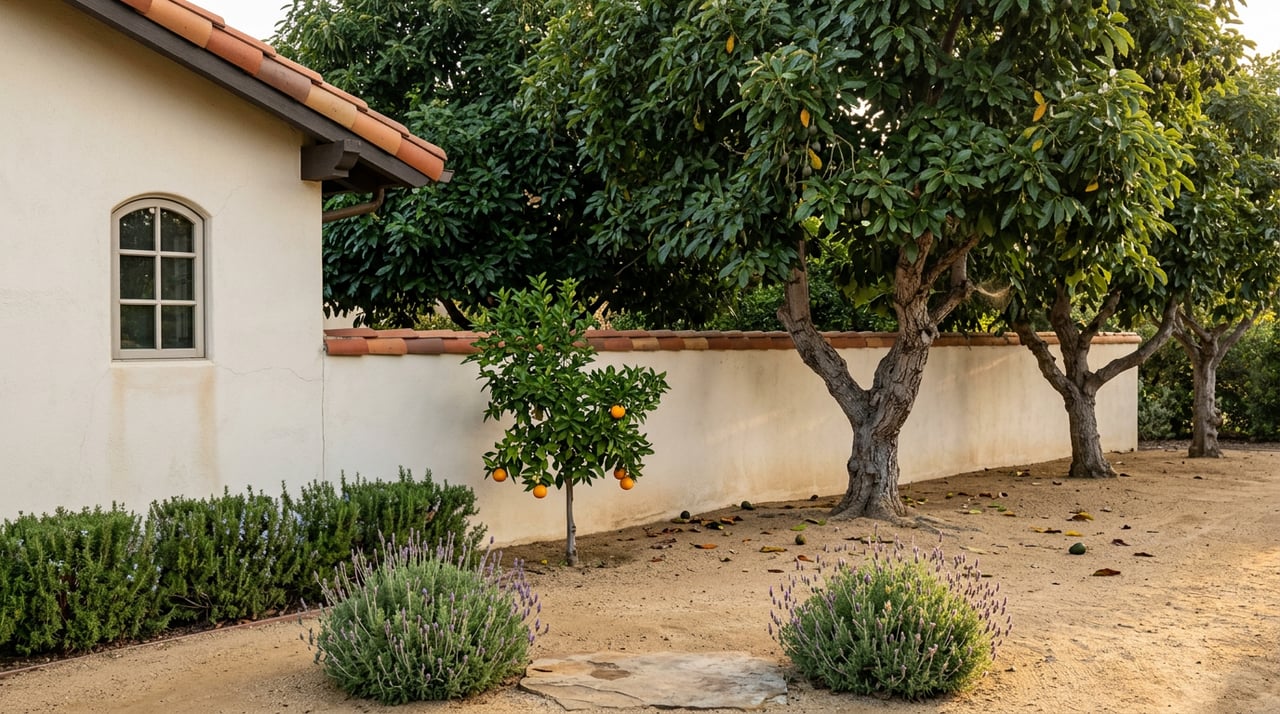
There's a road above La Cresta, out past the Santa Rosa Plateau, called Avocado Mesa. Nobody named it as a marketing flourish. It just got mapped onto a valley where the tree cover has always run more avocado than anything else. Most of the year you could drive it without thinking twice about the name. Right now, in the first weeks of August, is not most of the year.
Ask anyone in Fallbrook or De Luz when "avocado season" happens and they'll point you to April, to Main Street closing for the day, to a guacamole contest that's been running grudge matches since 1987. That's the 39th annual Fallbrook Avocado Festival, and it's real, and it's a genuinely good Sunday. It is also not when the fruit is at its best. The festival is a calendar event. The harvest is a biological one. They've never actually run on the same clock, and this year the gap between them is wider than usual.
The festival sets a date. The fruit sets its own.
Hass avocados don't ripen on the tree. They hang there, mature but rock hard, until someone picks them, and only then do they start to soften. That single fact is why "avocado season" resists a tidy start and end date the way a Fallbrook parade doesn't. According to the UC Cooperative Extension in Ventura County, Hass fruit can be picked anywhere from January through October, and once mature it can sit on the tree for up to eight months without spoiling. Growers use that window strategically, pulling fruit off gradually rather than all at once, which means the avocado you buy in August was never a leftover from spring. It's often the fruit that got to hang the longest and build the most oil content, which is the thing that actually determines how an avocado tastes.
Hass accounts for roughly 95 percent of everything grown commercially in California, De Luz included, so this isn't a footnote variety quirk. It's the rule for almost every tree in the valley.
This year the calendar slid even later than usual
That gap between the festival and the fruit is wider in 2026 specifically. The California Avocado Commission is forecasting 330 million pounds for the season, the fourth consecutive year the state has cleared 300 million pounds. Commission president Ken Melban described the timeline for how that volume moves through the year: harvest picked up through March, reached promotable volumes by late March, and then, in his words,
"The peak season will continue into August."
That's not the pattern from a decade ago, when the bulk of the crop cleared out by early summer. It means this week, right now, growers across the region are still actively pulling fruit rather than winding down. For a resident of La Cresta or De Luz, that translates to something concrete: the groves you'd drive past assuming the season had already peaked are, this year, still mid-harvest.
An old agricultural valley with a new operator or two
De Luz has grown avocados and citrus for more than a century, and the valley's reputation rests on a specific combination of conditions rather than luck: warm days, cool nights, and coastal fog rolling in over well-drained, decomposed granite soil. That's how Patel Ranch, a 20-acre grove founded this year, describes the microclimate that drew the family to the property in the first place. It's a useful data point on its own, because it means new growers are still choosing to put down roots here in 2026, a century into the valley's run as citrus and avocado country, which says something about how the underlying conditions haven't changed even as ownership does.
Not every operation in the valley runs the same way. A few miles from the family-scale groves sits a roughly 36-acre avocado property structured as a straightforward commercial investment, with day-to-day farming handled by a professional farm management company rather than an owner working the trees personally. It's a reminder that De Luz isn't just a collection of hobby orchards behind estate gates. There's real commercial agriculture threaded through the same back roads, operating on spreadsheets and management contracts alongside the family stands.
The valley's identity as farmland runs deep enough that even the properties not selling fruit lean on it. Flora Avocado Farm, a wedding and event venue on ten acres in De Luz, markets itself around the same ancient oaks, avocado trees, and citrus that define every working grove nearby. You don't get married under a canopy like that unless the trees were the point long before the venue was.
What a slower-ending season means if you're buying
If you've assumed the good fruit was gone once the festival banners came down in April, the actual biology argues the opposite. Late-hanging Hass fruit typically carries more oil content than early-season picks, which is the flavor difference between an avocado that tastes like wet cardboard and one that actually earns the hype. Growers like Patel Ranch sell direct from the property specifically because that freshness is the whole pitch, hand-harvested fruit that hasn't spent weeks in a distribution warehouse.
For a household in La Cresta already living alongside these back roads, the practical move is less about ceremony and more about timing. The festival is worth attending for what it is: a genuinely fun civic tradition with a free admission gate and a rivalry-fueled guacamole contest. The buying, if flavor is the goal, is arguably better done now, while the 2026 harvest is still running past its usual finish line.
Two different clocks, both worth keeping
The interesting part isn't that De Luz grows good avocados. Everyone who lives here already knows that. It's that the community has quietly organized itself around a calendar date, the April festival, that has almost nothing to do with when the fruit itself peaks. One is a party. The other is agriculture. Living here means you get to keep both clocks running, and this particular August is a good one to check the second.
If you're the kind of household that pays attention to which week the grove gates are busiest, you already understand what makes La Cresta and De Luz different from anywhere else in the valley. That's the same read on this pocket of Riverside County that guides how Jordona Hertz and her team work with families here, whether that means walking a buyer through what a five-acre parcel actually supports or helping a longtime owner think through what their land and grove are worth. When the conversation turns from avocados to real estate, our La Cresta neighborhood page is a good place to start, or you can reach out directly whenever the timing is right for you.